A Truck is a Beautiful Thing

A truck was dispatched to Kandale last Saturday from Kikwit. It was loaded with 300 bags of cement, roughly 7 1/2 tons, along with other materials. While the journey from Kinshasa is long and arduous, the trip down to Kandale has formidable challenges. There are small windows of time that lessen the difficulties, but the rainy season isn’t one of them. It had rained hard the previous week and the road down the Kwilu River valley was heavily eroded and complicated by slippery mud. Drivers are continually navigating new paths down, but there is no avoiding the steep muddy ravine. The team arrived at the bridge in the evening but there were several trucks still negotiating the difficult ascent on the other side with limited success. They were given approval at the bridge checkpoint to spend the night and they started out fresh in the morning.

They reached Gungu, a few miles away, after several hours of digging, backtracking, and slogging through the heavily rutted road. With the heat of the day underway, they decided to postpone the final leg to Kandale until the early morning. The road from Gungu to Kandale is primarily sand but the rain makes the sand heavy and the wheels of the passing trucks tend to burrow down into the ruts for traction and make the roads even deeper. The truck arrived on Monday the following day to a joyous crowd. The local crew had been mobilized days earlier to expect the truck on Saturday, and now that it had arrived. The crew made quick work unloading the cement. 

Prior to the trucks arrival the congregation spent the day preparing the road down to the Kwilu, (a different part from Gungu), to enable the truck to drive the five miles down and collect the large rocks that had been piled up.  It will require several trips to retrieve all the rocks that have been assembled. Once the rocks are unloaded in Kandale, the truck will return to Kikwit and retrieve the remaining materials needed to continue work on the roof of the first block of classes and the foundation of the second block. These materials include lumber, rebar, and corrugated tin for the roof.  When the truck returns for a second time it will again be repurposed to collect more stones and clean sand that is in abundance at the river.

The chain of construction wakes up long before the architect and the engineer arrive in March. Cement, rocks and sand are the primary components in the laying the foundations for the classrooms, but cement is also a key element for making bricks. Doka has taken time off from the grinders to prepare the brickmaking machine in anticipation of making bricks for future blocks. Fresh bricks may need a few weeks to dry before they are ready. They need to be kept in the shade, turned and watered daily until cured so that they are suitable for construction. The team will start making bricks on Monday and when Frederick and Olivier arrive they will have an ample source of bricks to begin work on the second block. In addition to making the bricks, several other individuals have been busy breaking the large rocks into smaller rocks to create concrete for the support columns and roof supports. Children have been organized to scavenge for small rocks, which will be included with the other gravel.

It can’t be over-stressed that there are many working parts that come into play for these projects to successfully move forward; from the organizers in the US, to the contributions from our donors, the many interactions with the dealers of construction materials in the Congo, the truck companies, and the hundreds of individuals organized on the ground collecting and processing all the materials by hand. And with every success it becomes increasingly more efficient and effective as the next project begins. A truck is a beautiful thing. It brings a promise for the future and keeps communities connected.

Donate

Happy New Year 2025!!!

Happy New Year!!! Every year is full of promises and challenges. Thanks to your ongoing support the solar powered water pump has been installed and the foundation for the first block of high school classes has been constructed. The REVE Kandale team in Kandale continues to keep all the programs up and running. 

The photo above includes growing corn and peanuts, the chaperone of the girl's dormitory, Dido Zunga and his wife, and the immaculate grounds of REVE Kandale

Maintaining all the grounds and preventing the jungle from encroaching is a full time job, especially during the rainy season. The people of Kandale are in the middle of the rainy season and everyone is busy managing their crops to sustain them through the next dry season. It is a process that has continued through many generations. The rainy season also provides a variety of locally sourced plants and mushrooms to supplement the standard diet.

Colette will be returning to Kandale in March. Prior to her arrival a truck will be transporting cement, lumber and tin to assemble the roof for the first block of classes. Frederic and Olivier will be directing the crew from Kikwit in the building of the new roof, as well as supervising the original crew in the digging of the foundation and building the walls for the second block. Depending on the timing, the roof for the second block will be installed as well. 

Even though the construction has paused, many individuals continue to collect large rocks to build the foundation for the second block of classes. In addition, several people are busy breaking rocks to ensure enough gravel is on hand to mix into the cement for the columns and roof supports. Another crew is busy making the needed bricks. The bricks require clay and cement, which requires more people to walk down into the ravines a half-mile away to collect the raw material. Upon arrival, the truck will be repurposed to gather sand and rocks down by the Kwilu River. There are many many moving parts that require a constant momentum and vision so that when the construction crew breaks ground all the pieces are in play.

Colette will be busy with preparations for the first ever Girls Soccer Competition on June 8th! Presently there are 16 villages registered to compete, with room for 6 more. Each village must pay a registration fee of $20 to ensure their commitment. With the registration fee each team receives a soccer ball to practice for the big match. 

A Committee of 8 people meets regularly to discuss the details. Leon Gisupa is the president and he convenes all the meetings. Leon is a former student of Mama Kanemu, the aunt of Dwight Shorts who is a major supporter of the soccer program in Kandale. Several of the members serve as recruiters who venture out to the local villages and observe potential teams. In March training will begin for the referees. In the past Congolese businessmen from Kandale have donated enough jerseys for all the teams. It goes along way to generate excitement for the event.

An outgrowth of this event is the potential for local entrepreneurs to set up stalls and sell food and refreshment. Tumba has been busy refining her recipe for beignets. 

Later in the spring ABCD will be presenting ideas for local development with a focus on the upcoming event. This competition will be even more exciting with the availability of water and grinders to prepare the flour. It will eliminate the stress of traveling down to the spring for water and having to prepare the flour by hand. The water pump and four grinders are gifts that keep on giving.

And finally, Ami Du Livre is a program that continues to support the young minds of the community. Colette started the program in 2015, but officially named it in 2022. It has become a multi-faceted learning experience for primary school kids. Matumba Madeleine, (seen above), oversees the program and she encourages the children to come in to the library and become familiar with the available literature. They get to draw in coloring books and attend storytelling sessions.

One of the fascinating elements of this experience is that they begin to learn Kikongo, their second language, both as a spoken and written language. There are no texts written in their mother tongue of Kipende other than the Bible. The government of the Democratic Republic of Congo has begun to introduce education programs for pre-school children and Ami Du Livre is right in line with that goal.

The REVE Kandale Community wishes you a joyous and prosperous New Year. We are grateful for the generosity of our donors and all the individuals that work behind the scenes to make this program successful. On that note our appreciation goes out to Eudes for keeping us connected with his excellent photos.

Donate

The View From Here

As of Wednesday afternoon the second cement cap was poured on the west wall, locking all the walls and columns into place. The structure now awaits the arrival of the wood and tin that will form the roof. As we head toward 2025, there are presently 6,000 bricks sitting and waiting for REVE Kandale to break ground on the next block of three classes.

The long drive from Kikwit to Kinshasa gave me lots of time to reflect on the short four week experience with the REVE Kandale community. After years of examining photos to include in the Communiqué, it dawned on me that I have come to know many of the people who inhabit those images. 

This photo was published back in April 2024 and it shows several of the people that have been featured recently. Bea, Olivier, and Frederick are along the back row. Several others in the photo were a daily fixture in the construction. Didier, second from the left, Aluma Aluma third from the left, and Ilunga Ilunga, seated in front with Jeremie to his right. Not a day went by that heart felt greetings weren't exchanged.

Here on New Year's Day several other important members of REVE Kandale are featured, Doka on the left, who works the flour grinder, Tumba next to him, who manages the kitchen and the surrounding forest, and Jeremie again on the right, who has been involved with REVE Kandale from an early age.

This image was included in February's Communique and features Prince on the left with Ilunga Ilunga and Bea working in the garden.

Here are Eudes and Merveille learning Excel, featured in March of 2022.
They look so young!

And finally here is a picture, on the left, of Nono and I after having walked to the other side of the valley in the heat of the sun. He was a great companion on the journey. Nono is in the middle of the photo on the right from June of 2023 behind the trophy. Nono always likes to be where the action is.

In many ways, their smiling faces prepared me for my arrival and made the transition easier. I looked back through the past several years of the Communiqué and found many people who I've come to know. They looked out for me and graciously welcomed me into the community.  It was an incredible experience and my heartfelt appreciation goes out to Colette and the REVE Kandale Foundation for allowing me to join this journey.

Donate

Once in a Lifetime

Two women arrived last Saturday each carrying two large basins filled with 20 pounds of raw clay. They had carried it for 12 miles or so from across the valley. These women are third generation potters working with local materials. They brought some pre-processed clay as well and wasted no time making these bowls. Their process was very similar to Maria Martinez' work, part pinch pot part thick coil, a process known around the world. The pieces were made in a shallow dish called a puki. The puki facilitates spinning the ceramic piece in the dirt and building it in 360 degrees. Without it, it is a clumsy process. 

The women use the simplest of tools, a thin knifelike piece of bamboo to scrape the outside of the pieces and a small disc of curved gourd to round out the inside. The finished pieces were placed in the sun to stiffen up until they returned in an hour to scrape and refine them. They returned on Wednesday and fired the pieces in a simple outdoor fire. The results were incredible.

These three women are in charge of preparing all the meals, doing laundry, hauling water and wood to cook the meals. Toomba Katoko on the right has been working with REVE Kandale since 2018. She is in charge of the kitchen and the caretaker for the forest. One of her jobs is to maintain a fire break during the dry season to keep the forest safe. Ade Mbatuva and Julie Ngombe help out Toomba when there are many guests.

Kisenda Munani or Sho Sho is the caretaker for the REVE Kandale compound. He begins work at 4:30 in the morning sweeping the grounds of all the leaves and mangos that have fallen in the course of a day.  He began work with REVE Kandale in 2020.  He has several goats that he manages and he spends his day as security guard and running errands. He is a go to guy.

Bea Kabisa has been working for REVE Kandale since 2021. Bea is the lead gardener and with four gardens to maintain, he is a busy person. Presently he has been creating a hen house to start raising chickens. Bea comes to REVE Kandale with a background in photography.

Doka Katoko started as a community volunteer planting trees. When the brick making machine was purchased he was trained as one of the operaters. Right now there is a big need to grind flour, but soon he will start making bricks again to anticipate the need for the next block of classes.

Leontine Lembesa has been working with REVE Kandale since May 2024. She was trained by James. She and her husband recently moved to Kandale where he is the director of the Kandale primary school. Leontine sings with the women’s choir every Sunday.

Stones, sand, rebar, bricks, gravel, wood boards, water and cement are in constant motion on this project. Many Communiqués ago I wrote, 'It takes a village', and nothing could be further from the truth. Many individuals have been reassigned to provide a steady flow of materials to maintain the pace. Church goers lended a helping hand after church. Children are constantly scrambling over the terrain to fill up pails with gravel, while in the shade of the mango trees others pound the big rocks into smaller pieces. The walls are almost complete and they have started pouring the support columns. Stay tuned for a final Communiqué reflection.

Donate

A 'Thoomp' in the Night

When the sun goes down in Kandale, it gets dark, pitch black dark. There is a solar powered device that I can use to read, but it lasts about an hour on a solar charge.  In the darkness the mangos fall outside the ‘tukul’, hitting the ground with a resounding ‘thoomp’, like an errant heartbeat.  Poe would be smiling.  As the season progresses the ‘thoomps’ increase in pace. The mangos litter the ground despite Sho Sho’s constant maintenance of the grounds. One must be vigilant walking beneath the large trees at the risk of getting bonked or worse, sprayed by an overripe fruit.  

There are so many mangos that people in town cannot eat enough and every one is a connoisseur. They are delicious There is an abundance of fruit at this moment, pineapples, bananas and even a plum like fruit that grows in the forest with an unusual sweetness. According to Colette, many mango trees were planted in the 1920’s when the first missionary, Gordon Pierce arrived. Many other fruit trees were planted as well, including orange trees as part of the vision of the first missionary who came here. The mango trees have thrived. In their 100 year old grandeur, they provide ample shade when not dropping fruits indiscriminately.

For the past several years the Communiqué has benefitted greatly from all the photos being sent. These two individuals have made it their job to keep us informed on the ongoing activities.

They have very important positions within REVE Kandale as well:

Merveille Gilatulu has been an on going presence in many of the Communiqués. She has been working with REVE Kandale since 2018. Her job title is Chef D’Equipe or Manager. She is responsible for most of the day-to-day operations, including managing the office and communications with Colette when she is in Kinshasa or the US. She keeps tabs on the progress of the water distribution and the grinder and is responsible for the overall upkeep of the grounds including the fences. She is also responsible for payroll which keeps everyone in her good graces. Under her initiative she created the ‘Réfectoire’, the outside meeting and dining area, which is often the focus for many events.

Eudes Mashini is the second person in charge and he is the focal point for all administrative support. Eudes has been working with REVE Kandale since 2022. He is responsible for the many administrative tasks including the monthly reports and sending out the photos for social media. He maintains the wifi and office equipment and helps people connect to the internet to send important documents. He documents the daily activities with his phone. Now that the African Cup of Nations is in full swing, he takes charge of the presentations on the wide screen TV in the evenings in the Salle Polyvalente when there’s a match.

It is a very interesting time to be in Kandale. As of three days ago, the rainy season began. It was abrupt. While it is the rainy season, the rain is intermittent and often presents itself with little warning. The work continues on the first block and the construction crew is taking full advantage of the opportunities to build when the skies are clear. They have completed all the work on the foundation and poured all the concrete caps. They have been working at a fast pace to secure the rebar infrastructure before pouring the concrete to level out the foundation. As of Saturday they have begun to build the final wall with bricks. They will probably finish with all the bricks at window height by the end of today.

In the next Communiqué, there will be more interviews with many of the people who work long hours to make sure that REVE Kandale continues to be fully operational. In addition, the Communiqué will document the progress of the construction, rain or shine.

Donate

All in a Week's Work

This is a picture of the construction team completing the foundation
for all the walls of the first block and preparing it for a
cement cap upon which the bricks will be placed.

We arrived in Kandale on Thursday. There were many welcoming parties from diverse parts of the community. After organizing all the sleeping arrangements and food, Colette was already assembling many of the people who would lead the projects in the days and weeks ahead. Right off the bat on Friday, Vodafone would be giving a presentation on the viability of installing a tower to facilitate the use of phones, which appear to be in abundance with the people in town. In the days ahead the projects include breaking ground on the first block of classes, completely reworking the turf of the football field, and painting the church.

We arrived in Kandale on Thursday. There were many welcoming parties from diverse parts of the community. After organizing all the sleeping arrangements and food, Colette was already assembling many of the people who would lead the projects in the days and weeks ahead. Right off the bat on Friday, Vodafone would be giving a presentation on the viability of installing a tower to facilitate the use of phones, which appear to be in abundance with the people in town. In the days ahead the projects include breaking ground on the first block of classes, completely reworking the turf of the football field, and painting the church.

The photo on the left depicts the site of a previous class in ruins upon which the new block of classes will be built. The photo on the right shows the site once the grass had been cleared and set on fire. The photo in the middle presents Colette with the construction crew. Colette has been reviewing the plans for the construction with Frederick, the architect, Olivier, the engineer, and the many seasoned workers assembled.

Colette’s days have been filled with many meetings including a meeting with the youth from several communities to begin work on the football field. Colette goes to great lengths in each of her meetings to explain the details of the project and the expectations for successful completion.  On Sunday after a 2 ½ hour mass, Colette met with the religious leaders to address their concerns.

On Monday while the boys were organized to work on the football field, Frederick and Olivier began mapping out the locations for the first block of classes. Strings were extended many hundred yards from the primary schools to orientate the next stage of construction. Then it was a matter of laying out the foundation, carefully measuring all the distances with the lines wrapped around stakes. Before lunch the team had finished digging the trenches that would become the foundation. By the afternoon cement had been poured into one of the trenches and Olivier began building the foundation with the rocks that have been thoroughly documented in previous Communiqués. It is not surprising that the foundation takes a great many rocks. The truck that recently delivered construction materials was able to help supplement the piles of rocks and sand, but it an ongoing process.

Painting the church inside and out was a very big job. 
It took the crew over a week to complete the many coats needed.

One of the most impressive components of this work has been the level of preparation. Each project has proceeded unimpeded due to the detailed meetings and the professionalism of the people involved. As Frederick and Olivier are not new to working in Kandale, they wasted no time in setting the construction work up for successful progress.

"Frederic" Kaniema-Ngika has been working with REVE Kandale since 2019 when he first came to evaluate the projects in Kandale. Colette was looking for an architect for the ongoing projects and interviewed several people for the position. Frederic's first job was to design the water catchment system for the Multipurpose Education Center in addition to the bases for the cisterns.

Since then he has rehabilitated several buildings, including the water depot and designed the many structures now being used including the primary schools. Presently, he is working on the first of eight blocks of classrooms. He has been instrumental in providing encouragement to the team and step by step instructions for the successful execution of each stage of the construction. He received his degrees at the Institute du Båtiments et des Travaux Publics å Gombé, Kinshasa.

"Olivier" Mwalela Kindeke started working with REVE Kandale around the same time as Frederic in 2019. His job title is Contremaitre and he is the lead builder for every step of each project since the construction of the primary school classrooms through the rehabilitation of the water depot. He is often found in many of the photos, guiding every step of the project. Olivier was recommended through a connection in the Congo. He received his education through the Catholic Mission in Kingandu as a Constructor.

All the work that has been done here has been done by hand. Every step is labor intensive from carrying the rocks and water, digging the trenches, mixing the cement, leveling the football field, and a host of other jobs. It is incredible and a testament to the commitment of the people working in the hot sun. In the weeks ahead the Communiqué will continue to follow the progress of the work being done. In addition many of the key members in this endeavor will be interviewed. Keep your attention here as there will be mangos in the next issue.

Donate

The Communiqué Has Landed

This a picture of Richard Suissa, his wife Godé and I.
We were roommates over 40 years ago.

It is impossible to understand the complexities of preparing for a trip to Kandale from Kinshasa. The list of things that are needed is very long and often turns into a search for the Holy Grail. Colette was very fortunate to have found a belt for the flour grinder very close to where we purchased printer ink. The issue then becomes will this belt work. If it does, then she will know where to get another, unless it is out of stock. The belt is needed as a back up. It is always important to have a contingency plan. There is no guaranty that a product will be available next week...or tomorrow. Things are in constant motion. Locating bidons for the construction, however, was a different story. We waited at least an hour for them to restock the supply from another location only to find out it was the wrong thickness. They will need strong bidons to carry the wet cement. The thinner white ones will not work. Colette is extremely adept at navigating the back roads of Kinshasa to locate beans and dried fish and even beautiful bolts of cloth. She has developed connections throughout and the local people value her loyalty.

We intended to depart at 4AM to get out in front of the suffocating traffic. It is a way of life in Kinshasa and you plan your trips accordingly. An organized chaos if you will. The truck was delayed and we didn’t get started until 8 AM. All the materials for the trip were packed at Colette’s mother’s house and it was a work of art the way everything was organized. After avoiding several traffic jams we hit the road and an hour later we realized that we had a flat tire with two punctures. We were incredibly fortunate to deal with a flat early on when repair shops and replacement parts are in abundance. I was unprepared for a 14 hour journey just to reach Kandale. We were five people speaking five languages, English, French, Lingala, Kikongo, and Kipende.  The road was in very good shape overall and according to Colette, it was significantly better than in years past. We arrived around 10 PM in the evening in Kikwit.

The next morning we left Kikwit at 6:30 and we took a road that was in very good shape and followed the Kwilu River south toward Tshikapa.  After about 2 hours we left the paved road and started on a punishing dirt road. The dirt road shook me from top to bottom for another four hours. I kept expected to see my suitcase and other large bundles being jettisoned from the roof. The strapping withstood all the bucking and rattling. The driver did an amazing job. It gave me an entirely different perspective about the challenges of working in Kandale and the Herculean effort being made to create the infrastructure. Colette had initiated communication with a team of technicians from Vodafone and we met up with them in Kikwit and traveled with them south to Kandale.

Upon arrival we were greeted with big banners and the local school band skillfully played a rousing melody with their drums and flutes. Entering into the compound it was amazing to see all the new structures first hand. It was a stark comparison to the many villages we passed along the way. We had a big lunch and sampled the mangos from the trees for dessert. We were then entertained with a traditional women’s dance. It was very compelling. Surprisingly, I am none the worse for wear after the trip, simply exhausted. The truck was unpacked and organized and Colette began her meetings with the REVE Kandale team. Tomorrow she is up at 5 AM to meet with the community and introduce the Vodafone team and explain the goals for their arrival.  After a 40 year absence I kept trying to overlay my memories on to what I was seeing from the truck, but the only thing that stuck out was how much remained the same, except more mobile phones, more motorcycles, but in general the streets were busy with people moving bundles from one place to another.

Colette and I will be here for a total of 4 weeks. No grass grows under Colette and progress has been on going and pervasive. In the next Communiqué I will be documenting the ongoing work on the new block of classes, the football (soccer) field and the work on the church.

Donate

A New New Perspective

The photo above is a 3D generated image of Kandale recently scanned by Google Earth.

In 2017, the REVE Kandale Foundation purchased a hand-cranked brickmaking machine in Belgium and had it shipped to Kinshasa, which in turn was transported to Kandale. This was the first step toward making a difference in the community of Kandale.* The vision behind this purchase was that this machine would lay the foundation for a whole host of projects, laid out, yes, one brick at a time…pun intended. 

*While the brickmaking machine was the first piece of machinery to arrive in Kandale, Colette has been working in the community and organizing its members since 2010.

This is the view of Kandale in 2017.

This is the view of Kandale in 2019.

In the March 1st, 2020 edition of the Communiqué, https://www.revekandale.org/communique?offset=1605872580943,

(scroll to the bottom),

the many changes to the topography were identified, of which The Multi-Purpose Education Center and the Caritas classrooms are dominant features.

The REVE Kandale team has been eagerly awaiting a new scan of the area by Google Earth. It arrived several weeks ago with great enthusiasm. The image of the town is a testament to that progress. The following images present a developing community, that is making a difference in the lives of individuals and families on a day to day business. It is important to understand that this image was scanned during the height of the dry season and many of the features may not be as green as one might expect. One feature of interest is the path, top center in the 3D generated image. It is the arduous path down to the spring. Hopefully by the next scan this path will be mostly grown over.

In the upper right corner of the 2D Kandale photo the two new primary school classrooms can be identified, providing 12 new classrooms to the community.

Just below the classrooms and to the left is the Multi-Purpose Education Center. In the photo on the left side of the building is the new array of ten solar panels and below the panels with the reddish roofs is the water depot with the two water cisterns to its right.

Right below the Water Depot is the rehabilitated garage that houses the two flour grinders. The array of solar panels powering the flour grinders can be seen on the roof. The circular roofs above are the tukuls nestled in the expanding forest.

And tucked down below the classrooms, the Water Depot and the flour grinders are the girls dormitories. They cannot be seen in the photo above, but they are present in the top photo way off to the right.

This final image above is a diagram of where the new classrooms will go. They will be located to the left of the new primary school. Each yellow rectangle represents a block of three classes and with 8 blocks, that's a total of 24 new classes, 12 for Gufwa Gubila high school and 12 for the Lycée. The blue rectangles are for administrative offices, one for each of the high schools. The pink ones are the latrines.

It is highly recommended that you observe these changes on Google Earth, the clarity of the images exceeds what can be presented in this Communiqué. One can even imagine the smaller dots are people queuing for water, accessing the flour grinders, playing cornhole Kandale-style or simply taking the time to share the day, (although they would probably be doing this in the shade). Seven years later the brickmaking machine remains fully operational and will be preparing the next round of bricks that will be used to construct the next series of classrooms. The Communiqué owes a great debt of gratitude to the people on the ground who have been documenting all the changes these past few years. The photos have been remarkable! Thank you!!!

Donate

It's Millet Season!!!

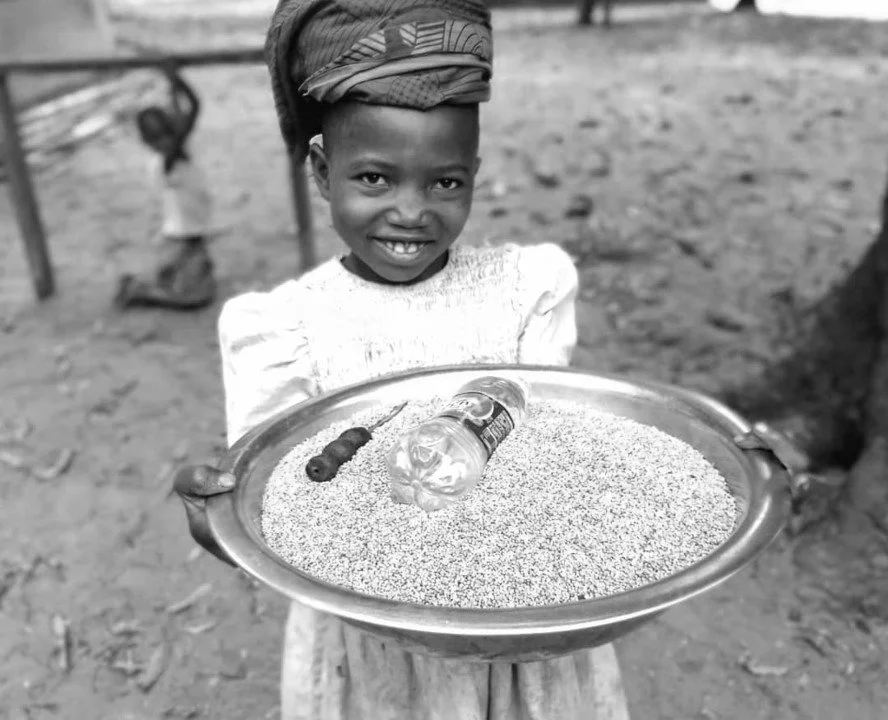
Toward the end of July the town of Kandale is buzzing with the harvesting and grinding of millet. The solar powered grinders have been working full tilt and have been processing as much as 78 kilograms per hour. Millet is both a cash crop and a staple of the diet as it accounts for 80% of fufu and cassava accounts for the other 20%. Fufu is a bread like food that is eaten at all meals. In Kandale, and for much of Africa, there are only two seasons, the dry season and the rainy season.  Presently the dry season is winding down and there has been no rain for 4 months. Food stocks are limited and the increased temperatures have impacted the millet harvest with some families having to sell off next year's seed stock to make ends meet.  

School starts in the beginning of September and many families are presently trekking for days and nights, some 80 – 100 kilometers, to distant woods and savannahs to collect caterpillars to raise enough money for school fees, uniforms and books. Many young people left the village at the beginning of the summer to find work and raise funds as well.  It is a challenging process and not an option for every family. In fact many families will often have to choose who will go to school and who will stay home to support them. 

In 2016, a survey conducted by the regional health center, concluded that 1,700 school age children in the 25 surrounding villages were unable to raise the fees needed to go to school. Only less than 1000 attended. Truth be told, limited classroom space has also been a deciding factor. REVE Kandale Foundation saw this as a call to action and began building new classrooms in 2018 for the Kandale Primary School, in order to maximize access to education.

Upon their return, high school students will be receiving both an academic education and an education in classroom building. With the on-coming rains and storms the high school classrooms are in constant need of attention. Not only do students bring their books and minds to class, but they also bring palm fronds and branches to shore up the roofs. 

The scenario is similar to building the boat while setting to sea. It is a precarious way to learn. 

With an impressive track record under its belt, the REVE Kandale Foundation is presently fund raising to build 24 high school classrooms. In October, if all goes according to plan, work will begin to layout the foundations for these classrooms. Just like building the classrooms for the Primary School, it will be a step by step process. There will be 12 classrooms for each high school. At the Institut Gufwa Gubila, there will be 6 classes for Math and Physics and 6 classes for classes in pedagogy to educate the next round of primary school teachers. At the Lycée, there will be 6 classes for sewing and six classes for accounting.

Like all communities, Kandale is eagerly looking forward to the coming school year. The changes have been monumental these past six years. Yes, life is not a walk in the park, but all the improvements build hope and confidence that the future will bring positive change. A perfect example of this hope is the preparation for next year’s girls soccer match. 

Watch the Mid-Year Appeal Video HERE,

for a better understanding of the current campaign

for the school construction project.

DONATE

Classrooms for Kandale

A classroom is more than just a building.


It is a place where dreams are created, futures are shaped, and boys and girls grow into young men and women.

High school students in Kandale, in the Democratic Republic of the Congo, have dreams like students everywhere. And they have hopes for a better future.

But they risk having their dreams deferred, and their futures are in jeopardy. 

What these students lack are classrooms where they can learn in a safe, nurturing environment.

This is where they need your help.

Most of the students in Kandale’s two high schools — Institute Gufwa Gubila and Lycée Gin’a Gisanga — study either in buildings made of sticks and straw or classrooms built a half-century ago that partially collapsed in a violent rainstorm in 2019.

They spend far too much class time gathering wood and straw to rebuild when the wind and rain prove too much — a frequent occurrence during the nine-month rainy season.

Michel Gajama Lundeya, headmaster at Institue Gufwa Gubila who arrived in September, says the conditions under which his students study “are deplorable.”

The buildings, he says, “are in a state of decay. The decay is very advanced. The children really need to study, but they have a lot of difficulties.”

With your help, we have provided that safe and nurturing learning environment for Kandale’s primary school, with 13 new classrooms built for younger students over the past five years.

With your help, we have brought safe, clean drinking water to the residents of Kandale.

Now we are beginning a new journey with a new goal — to build both high schools. We have engaged an architect who has visited the site and is now developing detailed designs and budgets. This is an ambitious goal, and we expect it will take several years and several hundred thousand dollarsto complete. But we will build the schools…bit by bit.

With enough help, we can start building the foundation this year. The walls and roofs will follow.

As it was said so eloquently by Mwatha Gutumbuga Nvulaku, former headmaster at Lycée Gin’a Gisanga: “Education is the basis of humanity.”

Education starts with a place to learn.

Please make a donation today and continue your support for the strong and resilient community of Kandale.

Only you can help us provide safe classrooms for the children


Kind regards,

Julie Martel

President, Board of Directors

REVE Kandale Foundation

DONATE